
Travel savings
How Much Money Do You Need to Travel for 6 Months?
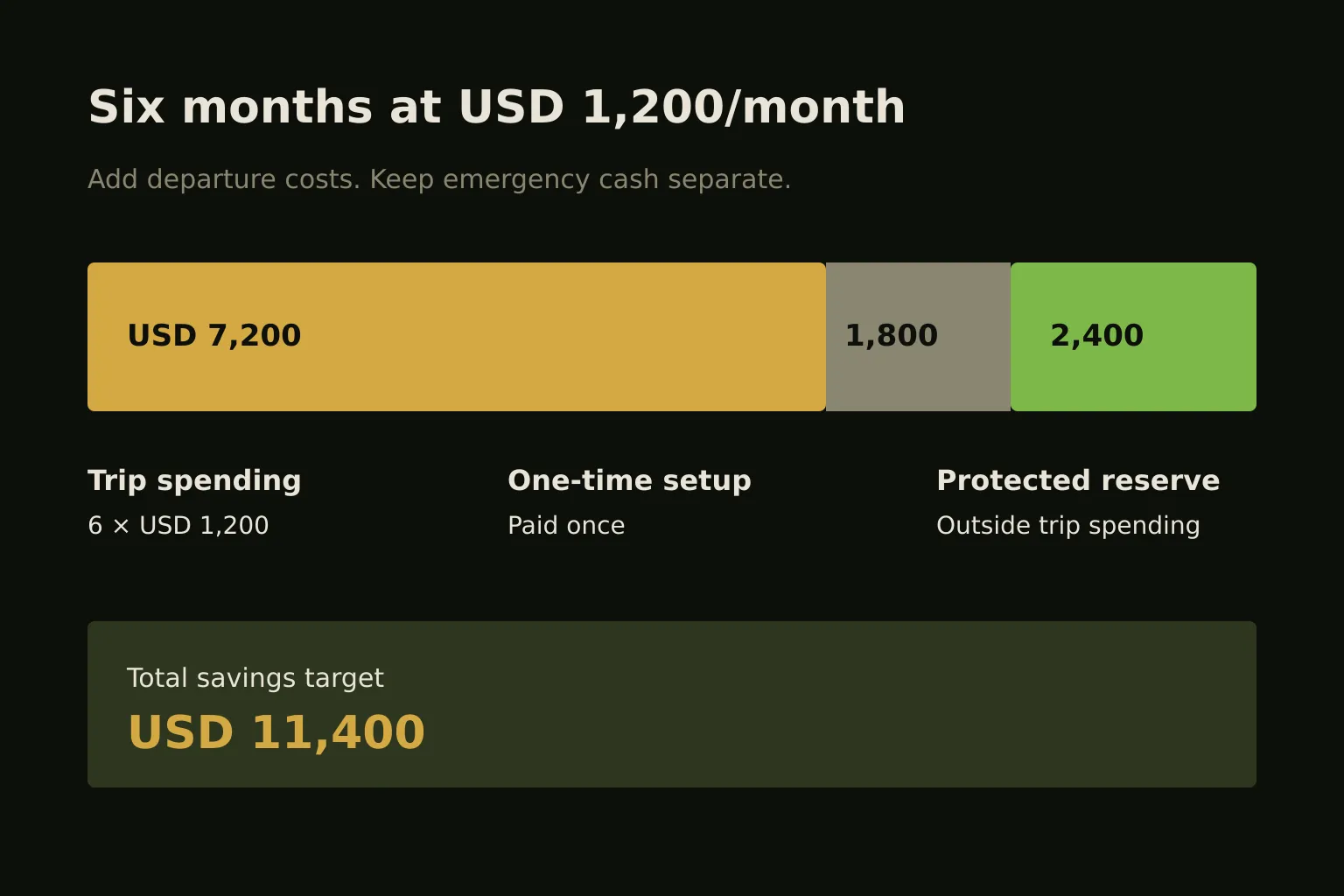
How much money you need to travel for 6 months depends on your route, but the savings calculation is straightforward: six months of spending, plus one-time departure costs, plus a protected emergency reserve. At a planning target of USD 1,200 a month, trip spending alone is USD 7,200. Your total savings target must also cover getting started and money you won't spend on the trip; USD 1,200 a month is not a guaranteed destination budget.
How much money do you need to travel for 6 months?
Use this formula before you decide whether your savings are enough:
Total savings needed = 6 × monthly spending + one-time setup costs + protected reserve.
Monthly spending includes bills that continue at home. Setup covers costs paid once. The reserve stays outside the everyday travel budget. This calculation assumes you pay for the trip from savings, with no new income while traveling.
If your route has different monthly costs, add the six monthly estimates instead of multiplying one average. An expensive final month still needs funding, even if the first month is cheap.
Put each expense in the right bucket
Start with your actual route and obligations. A hostel price alone won't tell you what a month costs.
| Bucket | What to include | How to count it |
|---|---|---|
| Monthly travel spending | Accommodation, food, local transport, activities, ongoing insurance, phone service and payment fees | Add recurring costs for each month |
| Bills back home | Loan payments, storage, subscriptions, or rent you still owe | Include them in monthly spending, even when you're abroad |
| One-time setup | Initial flights, gear you need, visa fees and insurance paid upfront | Add once, without also counting them monthly |
| Planned return and landing costs | A planned return ticket, transport home, and living costs before your next income arrives | Budget separately within setup or add an explicit return-cost line |
| Protected reserve | Unplanned costs, such as an urgent change of plans or an unexpected medical bill | Add to the cash target, outside planned spending |
A planned flight home belongs in your normal budget. Emergency money is for something going wrong, not an expense you already know is coming.
Use accommodation quotes for your dates, flight totals including baggage, and insurance quotes for your trip length. Check visa fees and permitted stays with the relevant government for your passport. Write the date beside each quote so you can refresh it before paying.
A six-month savings worksheet: USD 11,400
Say you plan to spend USD 1,200 a month, need USD 1,800 for setup and planned return costs, and choose to protect USD 2,400 for emergencies. These are worksheet assumptions, not verified travel prices or a recommended reserve.
| Part of the plan | Calculation | Amount |
|---|---|---|
| Six months of spending | 6 × USD 1,200 | USD 7,200 |
| Setup and planned return costs | Added once | USD 1,800 |
| Protected emergency reserve | Kept outside trip spending | USD 2,400 |
| Total savings needed | USD 7,200 + USD 1,800 + USD 2,400 | USD 11,400 |
Before departure, the plan contains USD 11,400 in cash. After paying the USD 1,800 setup allocation, USD 9,600 remains: USD 7,200 for the trip and USD 2,400 protected.
After the first month at USD 1,200, the balance would be USD 8,400. Only USD 6,000 of that is available for the remaining five months. Counting the whole balance as spending money would quietly spend the reserve.
Test a higher monthly budget before booking
Keep the same USD 1,800 setup allocation and USD 2,400 reserve, then change only monthly spending:
| Monthly spending | Six-month spending | Total savings target |
|---|---|---|
| USD 1,200 | USD 7,200 | USD 11,400 |
| USD 1,500 | USD 9,000 | USD 13,200 |
| USD 1,800 | USD 10,800 | USD 15,000 |
An extra USD 300 a month adds USD 1,800 to the six-month target. That difference could come from accommodation, more frequent moves, or bills you forgot to include.
If the higher-spending case exceeds your savings, compare a shorter trip, fewer moves, or different accommodation quotes. Don't make the arithmetic work by treating emergency cash as ordinary spending money.
How much more do you need to save?
Subtract cash already available from the total target. Include your protected reserve in both figures so you don't add it twice.
With USD 8,000 saved against the USD 11,400 worksheet target, the gap is USD 3,400. To close that gap over eight months before departure, you'd need to put aside USD 425 a month, assuming no interest or changes to the target.
If USD 425 is more than your current budget allows, move the departure date or revise the trip. A hoped-for freelance client, future refund, or unused credit limit isn't cash saved today. Keep any expected travel income in a separate scenario rather than using it to erase the savings gap.
How big should your travel emergency reserve be?
An emergency fund is cash set aside for unplanned expenses. The Consumer Financial Protection Bureau's emergency-fund guide says the amount depends on your situation and that the money should be safe and accessible. That primary source was checked on 11-23-2026.
For travel, price the disruptions you would need to handle: an urgent journey home, an insurance deductible, or somewhere to stay while resolving a problem. Consider what help you could actually access and what bills would continue. The USD 2,400 worksheet reserve isn't a universal answer.
Turn the worksheet into your own plan
Nomad Wealth Blueprint's free trip savings and runway calculator lets you enter trip length, monthly spending, setup costs and a protected reserve, then compare the target with your current savings. It also shows a higher-spending scenario and can reverse the calculation to estimate how long savings could last, without assuming new income.
Before committing to nonrefundable bookings, replace every worksheet assumption with costs for your route and dates. A plan is ready for review when departure costs, all six months, the planned return, and emergency cash each have a place in it.
Continue with this six-month worksheet
If you use the article’s assumptions: 6 trip months at USD 1,200/month, USD 1,800 setup, USD 2,400 protected reserve, USD 8,000 current savings and 8 months until departure, the total is USD 11,400, the savings gap is USD 3,400 and the monthly savings goal is USD 425.
Open these amounts in savings-target mode, then edit them for your route, costs and timing. They are planning assumptions, not verified travel prices or a recommended reserve.